File Formats
Supported input formats for ASAP.
LOOM format
ASAP accepts as input HDF5 files following the LOOM format, developed by the Linnarsson lab. Note that ASAP complies with the 3.0.0 specifications.
10x H5 format
ASAP accepts as input HDF5 files (.h5) from CellRanger developed by 10x Genomics. See the official specifications.
Plain-text format (compressed or not)
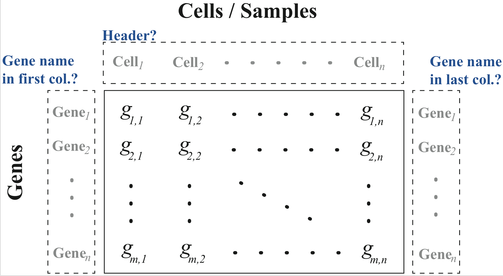
ASAP accepts as input simple plain-text matrices, with column delimiters such as tabulation, comma, semi-colon, or space. First or last column as gene names is optional; gene names are mapped to the Ensembl database. First line as cell/sample names is optional too. The file can be compressed.
H5AD format
From release 8, ASAP supports AnnData files (.h5ad). These files contain matrices, observations, variables, and embeddings in a single portable container that can be produced by tools such as Scanpy.
Archive
ASAP supports archive files that contain several datasets in a plain-text format. You can select which dataset to take as input in the interface.
Archive compressed
ASAP supports compressed archive files that contain several datasets in a plain-text format. You can select which dataset to take as input in the interface.
Compressed
ASAP supports compressed files (zip and gzip, and from release 8, we added bzip2 and xz).
MEX/MTX
ASAP requires all three files to be archived/compressed in a single file (.tar, .tar.gz, .gz, .zip, .bz2, .tar.bz2). The files need to be named:
- barcodes.tsv
- genes.tsv or features.tsv
- The main data matrix with extension .mtx. If several .mtx files are present, a file named
matrix.mtxis required and only this one will be used.
Until release 7 (inclusive), only archives with the three files are supported. From release 8, a simple zipped matrix is also supported.
RDS
From release 8, ASAP supports Seurat objects (.rds).